
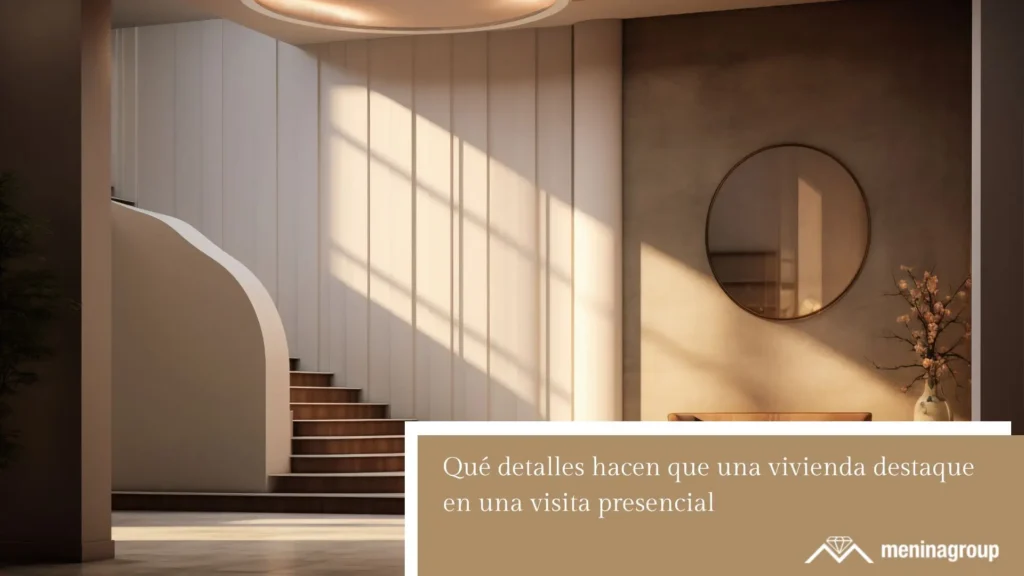
The majority of real estate purchasing decisions are not made online, they are made during the in-person visit. The photographs may attract, the price may generate interest, but it is in the tour of the home where the buyer decides whether or not to connect with the space.
In homes of a certain level, this difference is even more evident. Two properties similar in location and price can provoke completely different feelings when visiting them. This difference is not usually in the square meters or in the most obvious finishes, but in a sum of details that directly influence the buyer's perception.
From Menina Group We constantly analyze what elements make a home really stand out when someone walks through the door for the first time. In this article we address those key factors.
The first impression begins before entering
The experience does not begin in the room, it begins at the entrance. The buyer begins to form an opinion from the moment he arrives at the home's surroundings.
Details that influence from the first moment:
• Access status and cleanliness
• Sense of order in common areas
• Natural or artificial lighting at the entrance
• Environmental noise upon arrival
• Ease of access and orientation
A well-kept entrance positively predisposes the buyer even before seeing the interior.
Light as a decisive element
During an in-person visit, light is one of the most determining factors. Not only because of its quantity, but because of how it enters and how it is distributed in space.
Aspects that make the difference:
• Well-lit rooms naturally
• Curtains or blinds that do not block light
• Adequate use of artificial support lighting
• Sensation of spaciousness generated by light
• Absence of harsh shadows or dark corners
Many homes are significantly improved simply by adjusting how the light is displayed during the visit.
Silence and acoustic perception
The buyer is not always aware, but listen to the home. Exterior noise, interior echo or even installation sounds influence the feeling of quality.
Details that are perceived without being said:
• Audible nearby traffic
• Neighbor noises
• Excessive echo in open spaces
• Sounds from blinds, doors or systems
• Vibrations or hums
A silent home immediately transmits comfort, privacy and construction quality.
Order as an implicit message
It's not about decoration, but about order. Order conveys care, coherence and good management of space. Clutter, even if slight, is distracting and detracts.
Key aspects:
• Clear surfaces
• Well-defined spaces
• Absence of excessive personal objects
• Feeling of fluidity between rooms
• Well organized storage
The buyer should be able to imagine their life there without visual interference.
Invisible smells and sensations
Smell is one of the most influential senses during a visit, although it is rarely mentioned. A home can lose appeal in seconds due to an inappropriate smell.
Frequent errors:
• Musty odors
• Excessive artificial air fresheners
• Persistent cooking odors
• Lack of ventilation prior to the visit
A neutral, fresh and ventilated home generates an immediate feeling of well-being.
Coherence between rooms
When the buyer walks through the home, they expect a certain continuity. Sudden jumps between rooms generate disconnection.
Factors that provide coherence:
• Well combined materials
• Harmonious color palette
• Smooth transitions between spaces
• Logical use of each room
• Fluidity in circulation
It is not about luxury, but about spatial coherence.
Functionality is perceived without explaining it
A common mistake is trying to over-explain housing. When the space is well planned, the functionality understands itself.
Elements that facilitate this perception:
• Clear distributions
• Rooms with obvious use
• Well proportioned spaces
• Comfortable circulations
• Logical connection between day and night zones
When a space has to be justified too much, there is usually a basic problem.
The real state of the home
During an in-person visit, the buyer observes details that do not appear in the photos. Small defects can generate disproportionate doubts.
Aspects that are quickly detected:
• Doors that do not close properly
• Blinds or windows that fail
• Faucets with leaks
• Visible defects
• Feeling of irregular maintenance
These details don't usually break a deal on their own, but they do erode the overall perception.
The role of accompaniment during the visit
The way a visit is guided also plays a role. An excess of commercial speech generates rejection; A professional guide provides confidence.
A good accompaniment offers:
• Clear information without pressure
• Accurate answers
• Well-managed silences
• Ability to read the buyer
• Focus on what really matters
Therefore, a well-planned visit is part of the real estate services that make a real difference.
Pre-visit preparation
The homes that stand out do not do so by chance. There is prior preparation work that is not always visible, but is perceptible.
Includes:
• Lighting adjustment
• Adequate ventilation
• Review of small details
• Space organization
• Neutral staging
This process is part of a professional real estate ad well executed, where the in-person visit is the culmination, not an improvisation.
emotional closure
At the end of the visit, the buyer usually has a clear feeling, although he or she does not always verbalize it. That feeling is the result of all the previous details.
When a home stands out, the buyer:
• Remember the space clearly
• You imagine living there
• Perceive coherence and care
• Feel comfortable without knowing why
• Value the home beyond the price
That is the real objective of a well-worked in-person visit.
Conclusion
A home does not stand out in an in-person visit for a single element, but for the sum of many well-managed details. Light, silence, order, coherence, functionality and professional support build an experience that goes far beyond what is visible.
In the current residential segment, where the buyer is demanding and comparative, taking care of these aspects is not optional. It's what turns a visit into a decision.